Chicken curry, tomato sauce and wet pet food may all use retort pouches, but they place different demands on the filling line. Meat pieces can bridge at an outlet, thick sauce can leave a trailing string, and a correctly weighed portion can still contaminate the pouch mouth.
A retort pouch packaging machine must coordinate product delivery, pouch handling and closure. The useful measure is how consistently it produces correctly filled, cleanly sealed packs that can enter the specified downstream process.
2. From Empty Pouch to Sealed Pack
3. Controlling Solid and Liquid Portions
4. Handling Viscous and Particulate Products
5. Keeping Product Out of the Seal Area
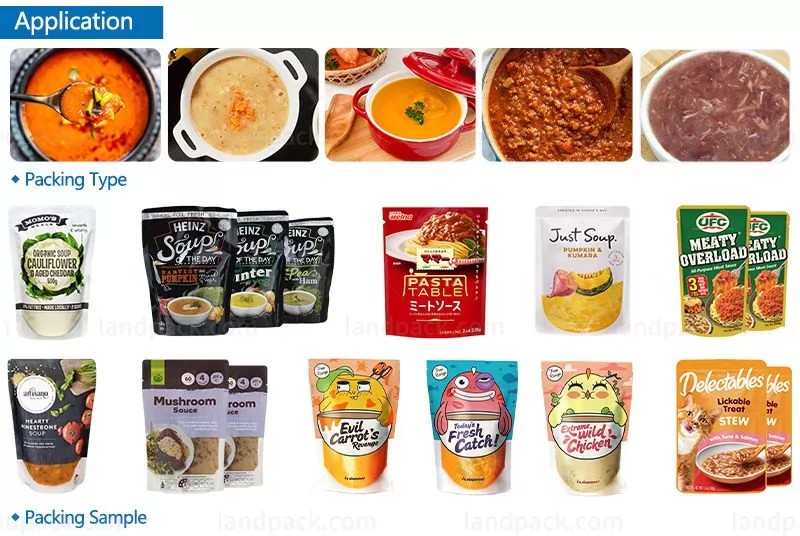
Retort pouch filling and sealing prepares a heat-resistant pouch for subsequent in-container thermal processing. Applications include ready meals, meat dishes, soups, sauces and wet pet food, with the filling arrangement determined by the actual recipe.
The filling and sealing machine and the retort sterilizer perform separate operations. Sealing alone does not establish commercial sterility or a shelf-life claim. For shelf-stable retorted foods, the product, pouch and downstream thermal process must be assessed together by a qualified processing expert.
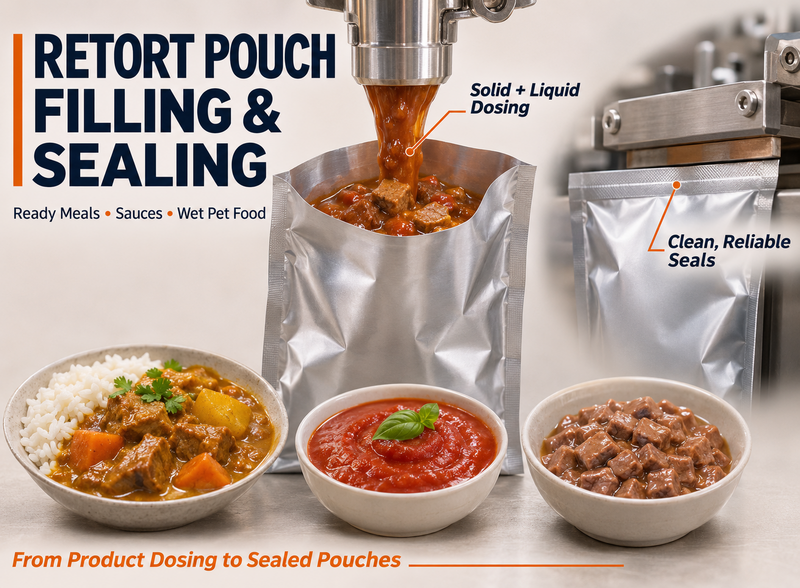
A typical premade-pouch sequence is pouch feeding, opening, filling, any specified air-removal step, sealing and discharge. Coding and inspection can be added at suitable positions. The station sequence changes with the product and equipment configuration.
In a rotary premade pouch packing machine, grippers index pouches through stations around a turntable. A horizontal premade pouch packing machine transfers them along a linear path. Either layout needs enough space and time for the required feeders, dosing heads and closure operations.
Pouch opening is particularly important for wet products. The mouth must remain positioned under the nozzle while the pouch body accommodates the incoming portion. Opening detection and a no-pouch/no-fill interlock should be specified where required and verified on the proposed machine.
For meat in gravy or vegetables in broth, final pack weight alone cannot reveal the ingredient balance. A pouch may reach its target weight while containing too little solid product. Separate dosing lets the two components be adjusted and checked independently.
One possible arrangement portions solids first, then adds sauce at a second station. Another fills a premixed product through a suitable pump. These are alternative process designs: a trial must establish which preserves the intended portion distribution and product appearance.
| Product | Dosing approach to evaluate | Trial observation |
|---|---|---|
| Meat or vegetables with sauce | Separate solid portioning and liquid dosing | Component balance and intact pieces |
| Smooth soups and sauces | Liquid filler matched to flow behaviour | Foaming, splash and end-of-dose drip |
| Thick curry or meat paste | Suitable positive-displacement dosing system | Flow stability, stringing and clean cut-off |
| Wet pet food | Recipe-specific paste or chunk-and-gravy arrangement | Texture, portion consistency and residue |
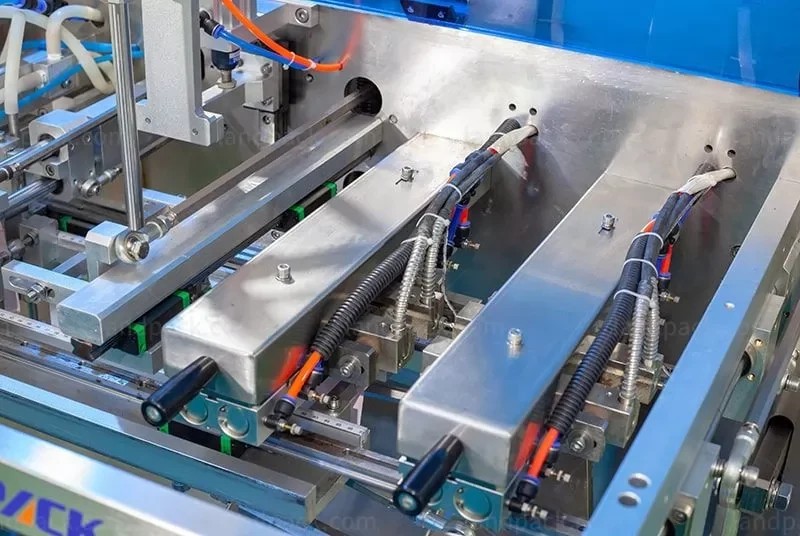
A product name is insufficient for filler design. Provide samples at the intended filling temperature, together with particle dimensions, fibres, visible oil separation and the expected production hold time. A sauce that flows freely just after mixing may behave differently after standing.
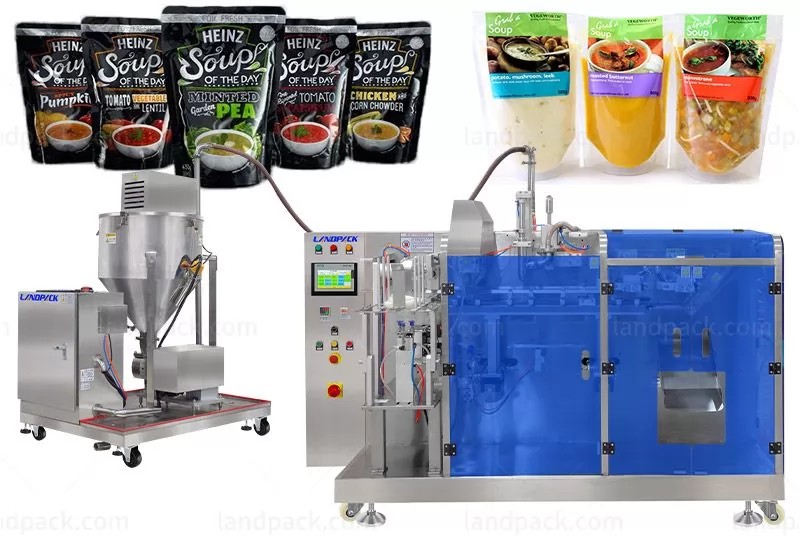
Landpack's published high-viscosity configuration includes a rotor measuring pump, a heated and stirred hopper, and a customized anti-leakage nozzle. These are configuration examples to evaluate, rather than standard features of every retort pouch machine.
For chunky food, evaluate the complete route from hopper outlet to nozzle. Ask whether the passage allows the largest pieces through, whether valves trap fibres, and whether pumping changes the texture. Check portions at the start, middle and end of a trial, including after a planned stop and restart.
Heating and agitation must suit the recipe. Define the permitted product conditions first, then assess the equipment needed to maintain them. Also review access to the hopper, valves, pump and product hoses for cleaning and inspection between recipes.
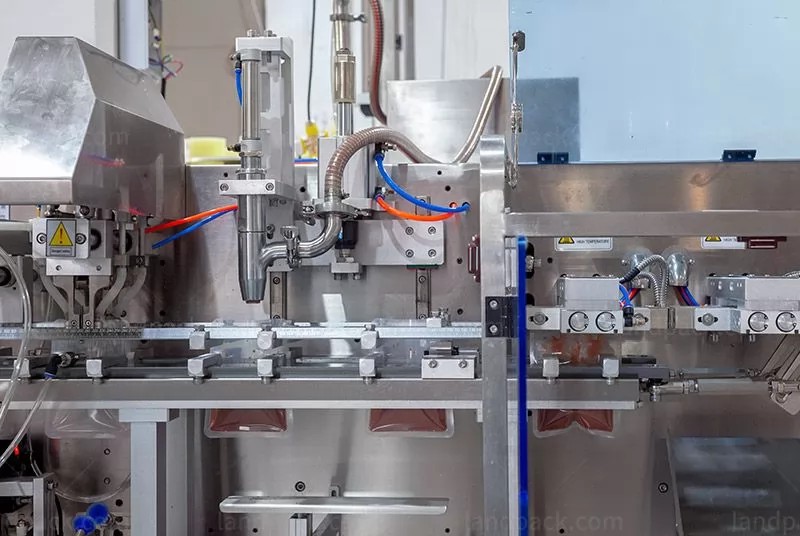
A drip after dispensing can land on the surfaces that must bond during sealing. Sauce splash, overfilling and product pulled upward during evacuation create similar problems. Seal-area protection therefore starts with filling.
Evaluate nozzle position, pouch support, dose speed and cut-off as a coordinated sequence. The nozzle should dispense into the opening without fouling its edges. Allow room for the portion to settle before the pouch moves, while maintaining the specified fill and headspace conditions.
For an intermittent defect, observe the last moment of dispensing and the following pouch transfer. A delayed drop or product string may be missed when attention stays on the main filling stroke. If contamination is detected, hold affected packs under the plant's deviation procedure rather than assuming another seal will correct them.
Residual air is a process variable, not a cosmetic target. Its acceptable level depends on the product, package and thermal-process design. A flat-looking pouch does not establish that its gas content meets the requirement.
Where vacuum is specified, excessive or poorly timed evacuation can draw liquid toward the seal area. Establish the air-removal method and settings through product trials against the process specification. Vacuum equipment is one possible configuration, not a universal requirement for every sauce pouch.
Foam and entrained bubbles deserve separate observation during filling trials. Record their behaviour after pumping and after a line stop, so an acceptable sample does not conceal variation during normal production.
Set sealing temperature, pressure and contact time for the actual pouch construction. A second sealing operation may be included in a machine configuration, but it does not independently prove seal integrity. Use the packaging supplier's specifications and an agreed verification plan.
Visual inspection can identify wrinkles or trapped product. Additional methods, such as seal-strength and leak testing, should be selected with the packaging and process specialists. Include packs after thermal processing and cooling when assessing the complete system.
Plan the handover from sealed-pouch discharge to retort loading. The process specification should govern waiting conditions and loading arrangements. Protect pouches during transfer, then provide appropriate cooling, handling, inspection and traceability through final packing.
For capacity planning, compare accepted output from the filler with retort batch capacity and turnaround. Faster filling can simply create a queue upstream of sterilization. Define how the line pauses, identifies held product and restarts when the downstream equipment is unavailable.
The filling and sealing machine loads and closes the pouch. Retort sterilization is a separate downstream operation with its own validated process.
A configured system can combine separate solid and liquid dosing stations. Suitability depends on piece characteristics, recipe, pouch opening and the available station arrangement.
Do not assume interchangeability. Test both recipes for particle passage, texture, dispensing behaviour and cleaning requirements; different product-contact components may be needed.
The specified product and thermal process determine the air-management requirement. Confirm the method and residual-gas criteria before specifying the equipment.
Use actual product and production pouches. Assess dosing, ingredient balance where relevant, product damage, pouch handling, contamination, rejects, stop/restart behaviour and agreed closure checks.
Effective retort pouch filling and sealing connects the recipe to the complete production process. Solids need controlled portions, viscous products need suitable delivery paths, and every pouch needs consistent handling through filling and closure. Commission the packaging operation together with its downstream interfaces.
Discuss your retort pouch filling project with your recipe, pouch samples, target fill weight and required output. Include particle size, filling conditions and the retort interface so the proposed configuration can be tested against your application.
